
Seven Signals Your Business Is Ready for Custom Software
Spreadsheets, manual handoffs, and tool sprawl are early warnings. Here is how to know when bespoke software is the smarter long-term investment.
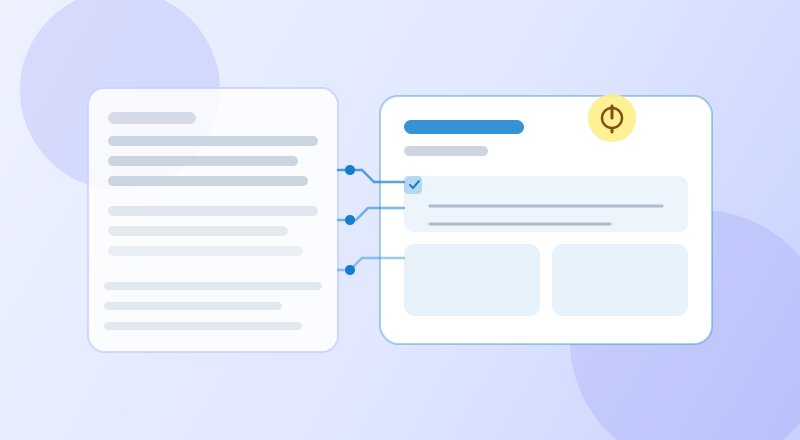
Most teams tolerate operational friction long after it starts costing real money. The question is not whether software can help — it is whether your processes, volume, and risk profile justify a purpose-built system instead of another SaaS subscription.
Seven signals we see before greenfield builds
Key points
- Critical workflows span three or more disconnected tools with manual copy-paste between them.
- Reporting takes days because data lives in spreadsheets owned by different people.
- Customer or student experience breaks at peak load because off-the-shelf limits were hit months ago.
- Compliance, audit, or IP requirements cannot be met with generic platforms.
- The product itself is the business — not a support function around someone else's software.
- Leadership has a 12–24 month roadmap that generic tools keep blocking.
- Engineering debt in no-code hacks now costs more than a focused build would.
Build when the cost of delay exceeds build cost
Custom software is not a vanity project. It is appropriate when manual work scales linearly with revenue, when errors have financial or reputational impact, or when differentiation depends on workflow nobody else ships out of the box.
A disciplined discovery phase — scope, integrations, ownership model, and MVP boundaries — keeps first releases focused. That is how Inievo helps teams avoid both perpetual spreadsheet operations and over-scoped version-one launches.
Continue reading
More from Insights
 Perspective
SME Growth
Why Every Online Shop in Bangladesh Needs a Real Website
Read article From Inievo Labs
Community
Building Hyperlocal Products for Chattogram and Beyond
Read article Perspective
AI & Automation
Where AI Automation Delivers Practical ROI for Bangladeshi Teams
Read article Deep dive
EdTech
Discussion
Comments
Share your perspective. Approved comments appear below after moderation.
Loading comments…